Jade rollers, gua sha and cryo tools: materials and handling

There is a great deal written about what these tools do. This is not that article. What a supplier can usefully tell you is what they are made of, how they behave, how they break and how to clean them — and that turns out to be the practically important part.
What we are not going to claim
Nothing in this range is a medical device, and no listing here states that a tool treats, reduces or improves any condition. Where you see such claims elsewhere they are generally not supported, and repeating them would be dishonest.
What these tools reliably do is feel cool, apply gentle pressure and help distribute product. That is a modest and accurate description, and it is the one we use.
Stone tools and what the stone actually is
Jade and rose quartz are natural stones, so colour and pattern vary between pieces and no two are identical. Dyed and reconstituted stone exists in this market and is usually detectable by an unnaturally uniform colour.
Natural stone holds cool for a few minutes and is dense enough to feel substantial. That thermal behaviour is the main functional property and it is genuinely different from plastic.
Stainless cryo globes work differently
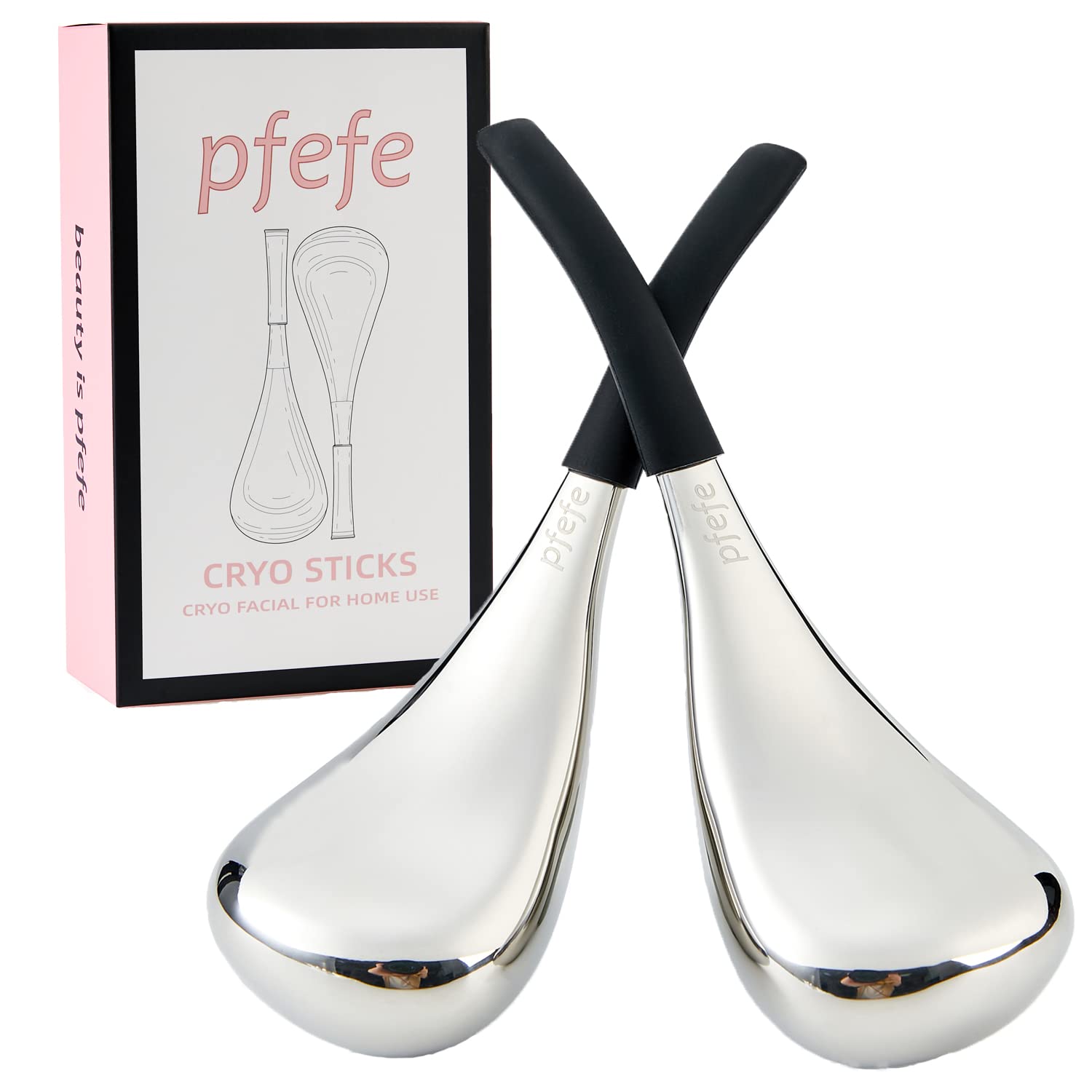
Cryo sticks and ice globes are steel shells with a fluid inside, chilled in a fridge. They hold cold considerably longer than stone and they do not warm as quickly under the hand, which is the practical advantage.
They also do not chip. For a busy room where tools get knocked, steel is the more durable choice by a wide margin.
How stone tools break
Almost always by being dropped on a hard floor, and often at the neck of a roller where the stone is narrowest. Natural stone has internal structure and a piece that has been dropped once may fail later without another impact.
A rolled towel on the trolley where tools are set down eliminates most of this. It is a trivial change that prevents the commonest breakage.
Temperature limits
Do not put stone tools in a freezer. Rapid temperature change stresses natural stone and can crack it, and a fridge achieves the useful part of the effect without the risk.
Cryo globes are designed for the fridge and some for the freezer — check the specific product. Boiling water is out for both categories, which rules out one common approach to sanitising.
Cleaning between clients
Warm soapy water and a soft cloth, then dry thoroughly. Stone should not be soaked, because water works into the join between stone and frame on a roller and loosens the fitting over time.
Steel tolerates more, but the seam on a cryo globe is a pressure seal and should not be submerged either. Wipe rather than immerse, for both.
Alcohol, disinfectant and what they do to a finish
Alcohol wipes are commonly used and they will dull a polished stone finish over time. Where your protocol requires alcohol, accept that the tools are consumables with a limited life rather than expecting them to stay pristine.
For steel this is much less of an issue, which is another reason steel suits a room with a strict sanitising routine.
Roller mechanisms and the squeak
Rollers develop a squeak when the metal pin at the axle dries or when product works into it. A very small amount of oil on the pin, wiped clean, resolves it. Product build-up at the axle should be cleaned out rather than lubricated over.
A roller that wobbles rather than squeaks has usually loosened at the frame and will not tighten reliably. That is the point to retire it.
Gua sha edges and why shape matters
The different curves on a gua sha tool correspond to different contours, and the comb edge is a different tool again. A piece with a well-finished, smoothly polished edge is more comfortable in use than one with a slightly sharp finish.
Run a finger along the edge when it arrives. A rough edge is a manufacturing fault rather than a design feature and is covered by our returns policy.
Buying for a room rather than for yourself
A working room needs more than one of everything, because a tool being cleaned is a tool not available. Two sets in rotation is the practical minimum and it prevents the temptation to rush the cleaning step.
Steel is easier to justify at that scale because it survives being handled by several people over a long day.
Facial tools in stock
- pfefe Cryo Sticks for Face & Eyes, 2-Count Black Stainless Steel Ice Globes — $23.49
- BAIMEI IcyMe Green Jade Roller & Gua Sha Set for Facial Sculpting – 2 Count — $7.49
See everything in Facial Tools.
Practical handling
Buy for material rather than for claims: stone for its feel and its cool, steel for durability and longer cold. Keep them off hard surfaces, wipe rather than soak, never freeze stone, and hold two sets in rotation.
Questions about anything above? Our FAQ covers the usual ones, the Shipping Policy has the delivery detail, and you can contact us directly — we answer within one business day.